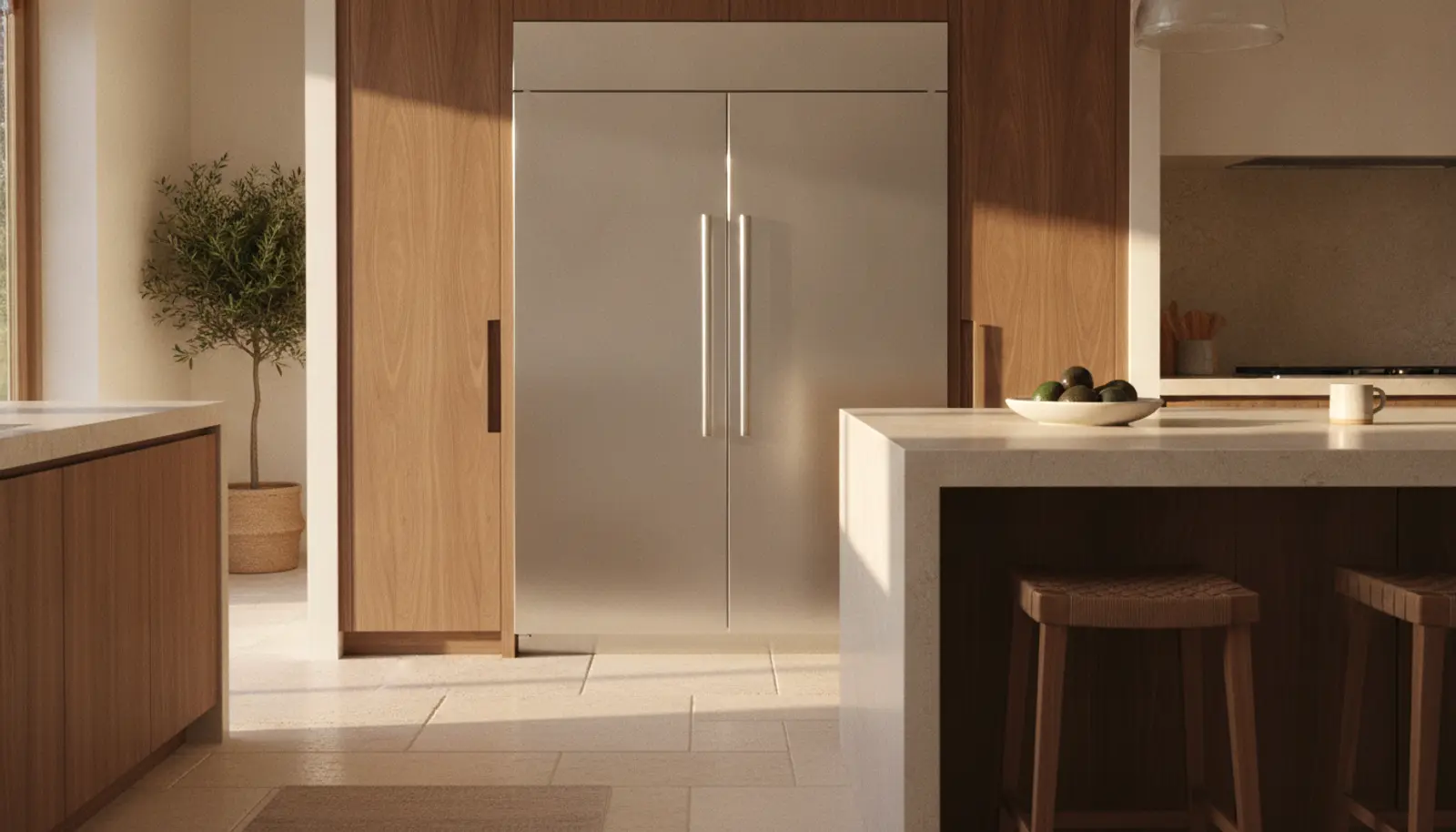
Built-in stainless side-by-side refrigerator flush in walnut cabinetry in a Southern California kitchen

Sub-Zero Repair · Built-In & Integrated Refrigerators · Out-of-Warranty · Southern California

Sub-Zero Refrigerator Repair across Southern California

A Sub-Zero refrigerator running warm usually comes down to one of three things: a condenser choked with dust behind the grille, a defrost or evaporator fault, or a door seal that's given out. Our techs at Zero Degree Built-In Refrigeration confirm the real cause first — and because these are Dual Refrigeration cabinets, we read which circuit is actually at fault before quoting anything.

Mon–Sat 8am–8pm · Sun closed · Requests 24/7 online, phone & chat

The short version

Warm cabinet? Usually a cheap, common cause.

Across the Southern California kitchens we work in, most Sub-Zero refrigerator calls fall into a short list: a condenser smothered in dust behind the grille, airflow lost to a frosted evaporator or a stalled defrost cycle, or a door that no longer seals. Fewer trace to the refrigerator's own sealed system, and fewer still are anything truly terminal — these built-ins are engineered to last decades.

From Pasadena and Brentwood to Newport Beach and La Jolla, the pattern repeats because the cause is mechanical, not regional. What changes the conversation is Sub-Zero's Dual Refrigeration: two independent circuits mean the refrigerator can run warm while the freezer beside it stays flawless. So the first job on every call is proving which system is actually at fault — and never charging you for the half that already works.

That's the order we work in: the cheap, common causes first, the sealed system last, and an honest number in your hands before anyone commits to a part.

What goes wrong

How Sub-Zero refrigerators actually fail

Most refrigerator calls we take across Southern California come down to a handful of patterns. A few are quick fixes; a few are not — and the point of a diagnosis is telling them apart.

A condenser choked with dust

The most common cause we find, and the cheapest. On a built-in the condenser sits behind the upper grille, and once it packs with dust and pet hair it can't shed heat — so the cabinet slowly runs warm even though everything sounds like it's working.

One Dual Refrigeration side running warm

Sub-Zero runs two independent sealed systems, so the refrigerator can drift warm while the freezer stays perfect (or the reverse). That split isn't a contradiction — it's a diagnostic gift that tells us which circuit to look at before anything is opened.

Frost packing the evaporator

When the evaporator ices over, cold air stops circulating and the box warms while the compressor runs non-stop. We read where the frost forms rather than just clearing it, because the pattern names the cause.

A defrost cycle that stopped clearing

Built-ins melt a thin layer of frost on a schedule. When the defrost components stop doing that, ice builds until airflow chokes off — a compartment that won't hold temperature even with a healthy sealed system.

A door that no longer seals

A worn gasket or a magnetic latch that's lost its grip lets warm kitchen air leak in around the clock. You see sweating, frost near the seal, and a compressor that over-runs — often misread as a cooling fault.

How we diagnose

A refrigerator diagnosis, in order

Built-ins reward a methodical read. We work the cheap, common causes first and only reach the sealed system once everything upstream is ruled out.

  1. Confirm which circuit is at fault

    Sub-Zero's Dual Refrigeration means the refrigerator and freezer have separate systems. We verify which side is actually warm first, so a healthy circuit never gets touched.

  2. Rule out the cheap, common causes

    Condenser cleanliness, airflow, and the door seal get checked before the sealed system — on a built-in refrigerator these account for most of the calls we take.

  3. Read airflow and the frost pattern

    Where frost forms — on the coil, the back wall, around the door — tells us whether we're chasing defrost, a gasket leak, or a fan, and saves guesswork.

  4. Verify the controls before the board

    We separate a genuine alarm from a transient display fault and check the sensors feeding the control, because a sensor reading wrong can starve a perfectly good cabinet of cooling.

  5. Reserve the sealed system for last

    If it comes to the compressor or refrigerant, we say so plainly, recover refrigerant under EPA 608, and give you the repair-versus-replace math on that specific cabinet.

Lower grille and condenser zone of a built-in refrigerator

Models this hits

Sub-Zero refrigerators we service

Refrigerator faults show up across both current and legacy lines. These are the cabinets we see most for refrigerator-side work — pulled from the model taxonomy we maintain.

  • Classic Series 2021–present (successor to BI)

    Built-in side-by-side, over-and-under, all-fridge/all-freezer; iconic grille

    • CL3650R
    • CL3650RID
    • CL3650RG
    • CL3650F
    • CL4250S
    • CL4250SID
    • CL4250SD
    • CL4850S
    • CL4850SID
    • CL4850SD
    • CL3050U
    • CL3050UID
    • CL3050UG
  • BI Built-In Series 1999–2014

    Built-in over-and-under (U), side-by-side (S), all-fridge (R) / all-freezer (F) Highest repair volume legacy line. Dual Refrigeration, magnetic door latch, vacuum condenser.

    • BI-30U
    • BI-30UG
    • BI-36U
    • BI-36UG
    • BI-36S
    • BI-36R
    • BI-36RG
    • BI-36F
    • BI-42S
    • BI-42SD
    • BI-48S
    • BI-48SD
    • BI-48SID
  • 600 Series 1994–2000s

    Built-in side-by-side and over-and-under Variants -2 / -3 (e.g. 650-2/3, 685-3, 695-3).

    • 601R
    • 601F
    • 611
    • 632
    • 642
    • 650
    • 661
    • 680
    • 685
    • 690
    • 695
  • 700 Series 1997–2007

    Built-in, tighter footprint; T=top-over-bottom, B=bottom config, I=ice Variants -2 / -3 exist. Mechanicals under bottom drawer near floor.

    • 700TR
    • 700TC
    • 700TF
    • 700BR
    • 700TCI
    • 700TFI
    • 700BFI
    • 700BC
    • 736TC
    • 736TCI
    • 736TR
    • 736TFI
  • Designer Series current

    Fully integrated columns (refrigerator/freezer), drawers, undercounter — flush cabinetry DEC = column, DET = drawers, DEU = undercounter, *W = wine.

    • DEC2450FI
    • DEC2450RA
    • DEC3050RA
    • DEC3050W
    • DEC3050WH
    • DET3050CI
    • DEU1550B
    • DEU2450CI

Repair or replace

An honest call before you spend

A Sub-Zero built-in is engineered to outlast most kitchens. That changes the math: a single failed fan, gasket, defrost component, or a dust-choked condenser on an otherwise sound cabinet is almost always worth repairing, even on a unit that's fifteen or twenty years old.

Where we get cautious is a failed sealed system on a very old refrigerator — a compressor or a refrigerant fault. There the cost climbs, and on the oldest cabinets replacement can be the smarter spend. We give you that read straight, with the numbers for your specific model, so the decision is yours and not a sales pitch.

Straight talk on price

You pay fair, market-average rates: a Sub-Zero takes the same skilled work as any built-in, so you're not paying a premium for the badge.

Ranges are estimates by model and fault; the exact price is confirmed on-site, and you approve the work before we start. No flat fees, no surprises.

Refrigerator questions

Sub-Zero refrigerator repair FAQ

Why is my Sub-Zero refrigerator not cooling?

Most no-cooling calls trace to one of three things before anything serious: a condenser packed with dust behind the grille so heat can't escape, airflow lost to a frosted evaporator or a weak fan, or a door that's stopped sealing. A failed compressor is possible but far less common, which is why an accurate diagnosis usually saves money rather than costing it.

My Sub-Zero refrigerator is warm but the freezer is cold — what does that mean?

That points straight at Sub-Zero's Dual Refrigeration. The refrigerator and freezer run separate sealed systems, so one can drift warm while the other stays perfect. A warm fridge with a cold freezer is a useful clue, not a contradiction — it tells us to diagnose the refrigerator circuit specifically.

How often should the condenser on a built-in Sub-Zero be cleaned?

The condenser behind the upper grille collects dust and pet hair over time, and a clogged condenser is the single most common reason a built-in runs warm. Periodic cleaning keeps it shedding heat properly; in dusty or pet-heavy homes it needs attention sooner. We check and clean it as part of any cooling diagnosis.

Do you repair discontinued refrigerators like the 650 or BI-48?

Yes — legacy built-ins are most of what we do. We service the 600-series including the 650, the BI built-ins including the BI-48, the 700 and 500-series cabinets, and the current Classic and Designer lines. Parts for many older Sub-Zero refrigerators are still available, and we keep genuine OEM components on the truck.

Is it worth repairing an older Sub-Zero refrigerator?

Usually, yes. These cabinets are built to last decades, and the common faults — a dusty condenser, a fan, a defrost component, a door seal — are inexpensive relative to replacing a built-in. The exception is a failed sealed system on a very old unit, where we give you the honest repair-versus-replace math for your specific model.

How much does Sub-Zero refrigerator repair cost?

It depends on the model and the failure, so we quote ranges by symptom rather than a flat fee. You pay fair, market-average rates: a Sub-Zero takes the same skilled work as any built-in, so you're not paying a premium for the badge. A condenser cleaning and a sealed-system repair sit at very different ends of the scale, and we tell you which one you're facing before any work begins.

Do you use genuine Sub-Zero parts on refrigerator repairs?

Yes. We install genuine OEM parts because the door gaskets, control boards, fans, and sealed-system components are matched to the specific cabinet, and a close-enough aftermarket part is how built-ins end up back on the bench. Zero Degree Built-In Refrigeration keeps common Sub-Zero components on the truck so most repairs finish in one visit.
Tell us the model and what the refrigerator's doing.

Mon–Sat 8am–8pm · Sun closed · Requests 24/7 online, phone & chat